
The Süreyya Journal · 25 October 2026
Hum Honey: The Sweet Story Behind Süreyya Kahve's Cups
Hum Honey: The Sweet Story Behind Süreyya Kahve's Cups
Post 3 in our weekly Süreyya Kahve Wellness Cups series
A little sweetness can make a breakfast feel like a treat. But the ingredient behind that sweetness matters too, not as a shortcut to a health claim, but as part of the care and craft that goes into a good cup.
At Süreyya Kahve, Organic Hum Honey is one of the ingredients that brings a gentle sweetness to many of our Wellness Cups. Behind it is a family business with a story rooted in the Sunshine Coast Hinterland, a thoughtful approach to beekeeping and an award-winning line of infused honeys.
A family project that found its hum
Hum Honey began as a side project. Leisa Sams, known as “Bee Girl”, and her family were supporting a Land for Wildlife bush regeneration effort on their property. Bees became part of that relationship with the land, and honey became a way to share what the local environment could offer.
The name Hum Honey captures a small but memorable detail: the contented hum of healthy, well-cared-for bees. It’s a name that reflects the business’s intention to work with the bees and their surroundings, rather than treat honey as just another commodity.
Based in the Sunshine Coast Hinterland, Hum Honey is an award-winning boutique family business. Its bees forage among subtropical rainforest and open forest hardwoods, and the business describes its approach as sustainable, stationary beekeeping using organic methods. Hum Honey says its bees are not treated with chemicals or antibiotics, and its honey is not heat-treated.
You can read more about the people and philosophy behind the business on Hum Honey’s About page.
Raw honey, with care in every jar
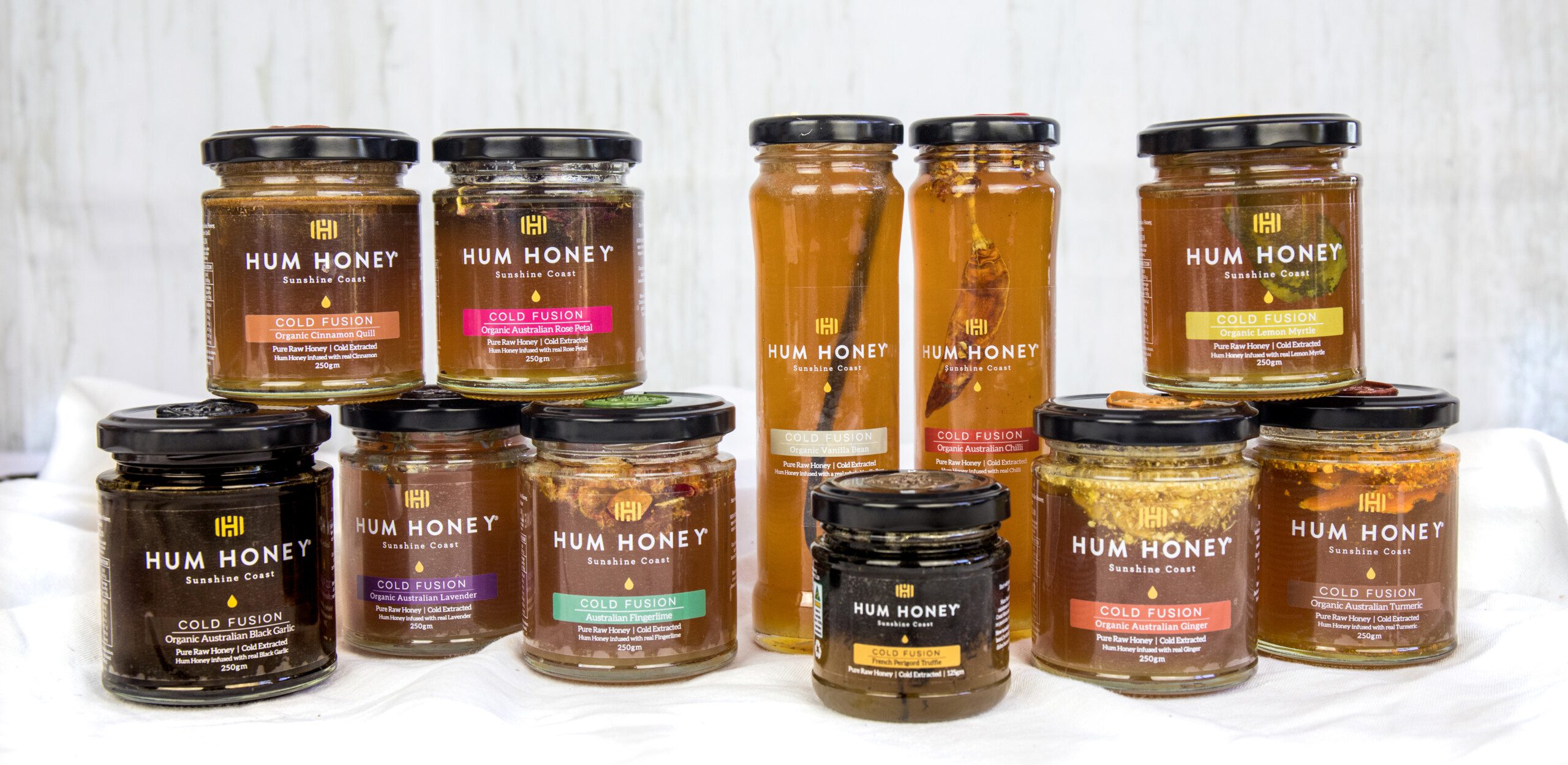
Hum Honey produces pure raw honey and its distinctive Cold Fusion infused range. Rather than heat-treating the honey, Cold Fusion combines raw honey with selected flavours. The result is an expressive ingredient that can add a little character to a breakfast, a cheese board or a favourite recipe.
The range earned national recognition in 2018: Hum Honey Cold Fusion won the Best New Australian Made Product award at Fine Food Australia. The Sunshine Coast Council reported that the product was recognised among more than 400 entries. It’s an achievement that reflects both the creativity of the infusion process and the care behind a small Australian producer’s work.
That award is part of Hum Honey’s story, not a promise about what honey can do for your health. The appeal here is simpler: a distinctive, carefully produced ingredient with a sense of place and a flavour that works beautifully in food.

Why choose honey as a sweetener?
Honey has a long culinary history. Its aroma and flavour can add more than sweetness, helping fruit, oats, spices and creamy textures come together. In a breakfast cup, it can be a considered alternative to highly processed sweeteners when you want an ingredient with a familiar food story and a distinctive taste.
But “natural” does not mean “sugar-free,” and honey is still a sweetener. The amount matters. Australian dietary guidance recommends keeping added sugars, honey and syrups to a minimum. The World Health Organization also includes sugars in honey among free sugars, which are best limited as part of a balanced diet.
So the thoughtful approach is not to treat honey as a health food or use it without limit. It’s to enjoy it in moderation, alongside the other ingredients in a meal, and to choose it because it suits the taste and character of the food.
A note on erythritol
You may have seen discussion about erythritol, a sugar alcohol used in some products as a low-calorie sweetener. Research has raised questions about possible associations between erythritol levels and cardiovascular events, but those findings do not prove that eating erythritol causes heart disease. The evidence is still being examined, and it would be misleading to describe erythritol as definitively dangerous.
For us, the practical point is modest: if you prefer a wholefood sweetener, honey is one option to consider. It is not a way to avoid sugars altogether, and it should still be used in moderation. For more on how we approach everyday wellbeing, explore KAILO and its focus on considered routines that fit real life.
A thoughtful ingredient across the Wellness Cups menu
Hum Honey appears in the sugar breakdown of nearly every Wellness Cup. It’s part of the balance of flavours in cups such as Strawberry Gum and Papaya Mint Overnight Oats, Supangle Chia Pudding and the Tiramisu OatChia.

In Strawberry Gum, honey brings sweetness alongside strawberries and tiger nut milk. In Papaya Mint, it complements ripe fruit and fresh mint. Supangle pairs its measured amount with chocolate, Greek yoghurt and pistachio. In Tiramisu OatChia, honey is part of a layered dessert-inspired cup with oats, chia, tiger nut milk and Greek yoghurt.
These are not identical recipes, and the amount of honey varies from cup to cup. The menu’s sugar breakdown gives a useful ingredient-level picture: for example, it lists 9.4 grams from Organic Hum Honey in Strawberry Gum and Papaya Mint, 4.7 grams in Supangle and 23.5 grams in Tiramisu OatChia. These figures are estimates per cup, as provided on the menu. They help show how sweetness fits into each recipe rather than asking one ingredient to tell the whole story.

Sweetness with a story
An everyday breakfast can be both practical and a pleasure. Choosing ingredients with care, from the oats and fruit to the honey, can make that ritual feel a little more considered.
Hum Honey brings a local family story, an award-winning approach to flavour and a thoughtful relationship with its bees to the Wellness Cups menu. And when the cup is finished, what remains is the simple pleasure of a meal made to be enjoyed.
Explore the full Süreyya Kahve Wellness Cups menu to find your next favourite. CHOOSE YOUR CUP, SLOW DOWN AND SAVOR THE GOOD STUFF.
Read more about Hum Honey’s 2018 award, the Australian Dietary Guidelines and the research on erythritol and cardiovascular risk.
Enjoyed this story?
Back to The Süreyya Journal